SFDR 2.0: key EU Parliament amendments shaping the upcoming trilogue
On 15 September 2026, the EU Parliament’s ECON committee published its negotiating position on the SFDR 2.0 proposal, which includes a number of additional amendments tabled since its draft report of April 2026 and suggests closer alignment with the Council of the EU. While the EU Parliament still needs to approve the negotiating position, no further major changes are expected at this stage.
Background
On 20 November 2025, the EU Commission published its legislative proposal to amend Regulation (EU) 2019/2088 on sustainability-related disclosures in the financial services sector (SFDR), often referred to as “SFDR 2.0”. The proposed changes aim to provide investors with clearer, more decision-useful information, while streamlining disclosure requirements and reducing compliance costs for financial market participants (for more details, read our newsflash here).
The ECON committee published its first draft report on the SFDR 2.0 proposal in April (see our newsflash here). Further changes have since been made, in an effort to move the proposal towards greater clarity for investors while at the same time reducing administrative burdens.
Key takeaways
The latest position of the ECON committee, adopted on 10 September 2026 and published earlier this week (available here), entails the following amendments compared to the ECON draft report published in April 2026:
- The proposal to treat manufacturers of packaged retail and insurance-based investment products (PRIIPS) as financial market participants, introduced in the ECON draft report, has been removed.
- For the transition category, exclusion requirements apply to fossil fuel companies unless they (i) allocate at least 20% of their CAPEX to Taxonomy-aligned activities, (ii) have a time-bound and measurable strategy to reduce their Scope 1 and 2 GHG emissions that is aligned with the Paris-aligned decarbonisation strategy, (iii) have a coal/lignite phase-out plan (where relevant) and (iv) allocate over a three-year period a higher average CAPEX to Taxonomy-aligned activities than to new fossil fuel projects.
- AIFs marketed exclusively to professional investors are able to opt out.
- Government bonds are eligible for Article 7 products, as long as they are aligned with the transition objective and do not represent more than 15% of the portfolio.
- The additional requirement to eliminate at least 20% of the lowest rated securities when applying an average rating or sustainability indicator for the ESG basics category, as introduced in the ECON draft report, has been removed. Instead, when applying sustainability indicators, at least two appropriate sustainability indicators must be used. For the application of ESG ratings, no new requirements have been added.
- Timing: while the application timeline of 24 months post-entry into force remains as proposed in the ECON draft report, certain articles related to the scope of the regulation, such as the new scope of the definition of financial market participant, will start to apply as soon as the legislation enters into force.
The three trilogue positions
Recent amendments to the EU Parliament’s position suggest a growing alignment with the approach of the Council of the EU on several key aspects of the proposal. As a result, many of the potentially contentious policy issues may already have been largely resolved before trilogue discussions formally begin. For example, both the Council of the EU’s position and the latest EU Parliament proposal allow alternative investment funds distributed exclusively to professional investors to opt out of the requirements and include a disclaimer requirement for non-categorised products, increasing the likelihood that these elements will be reflected in the final text. This could allow negotiations to focus more heavily on the finer details of the application and implementation requirements.
The table below outlines some of the positions of the EU institutions ahead of the trilogue negotiations.
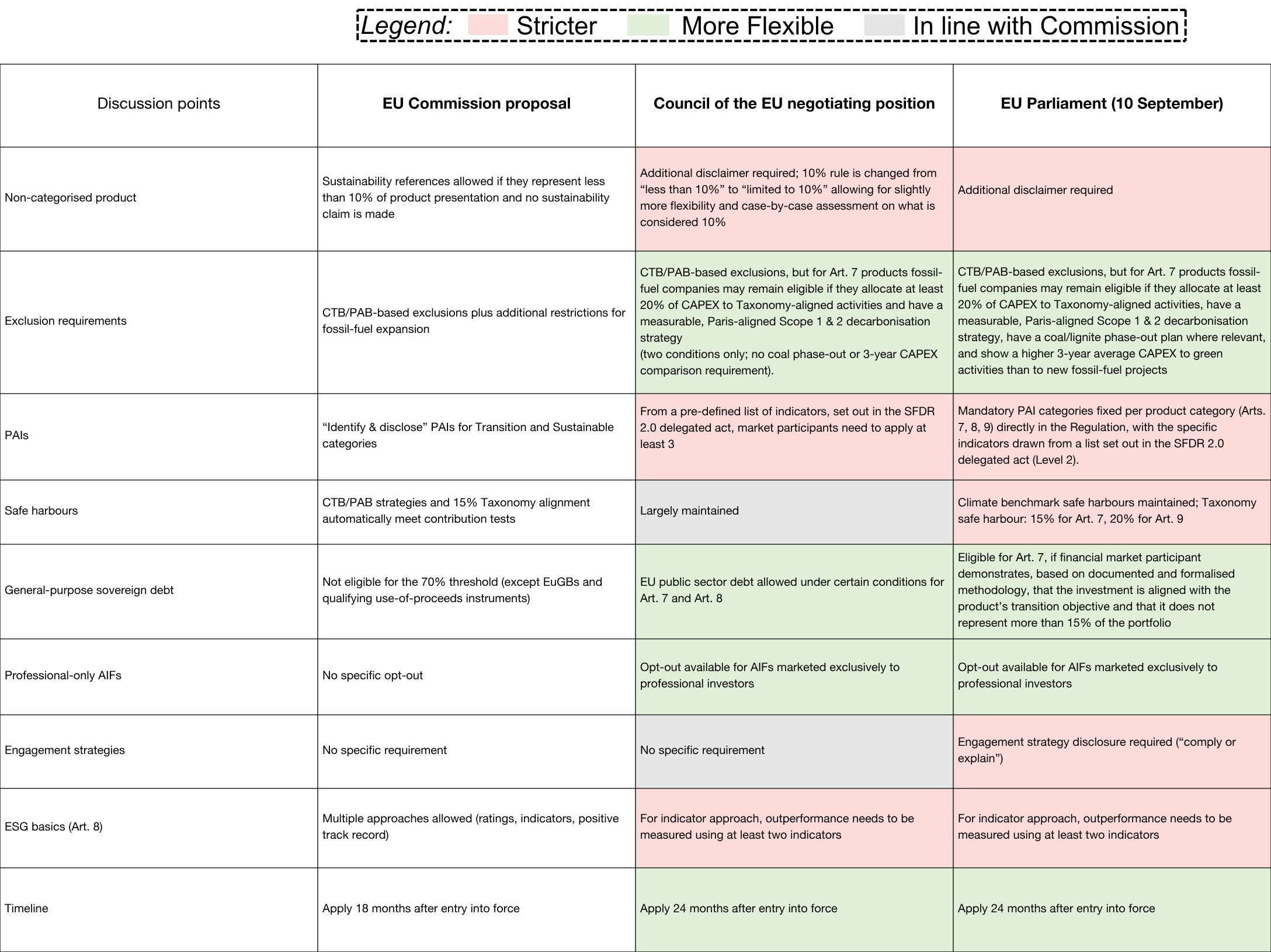
*Non-exhaustive and subject to changes. The table reflects the EU Parliament’s position as adopted by the ECON committee on 10 September 2026, ahead of the EU Parliament plenary vote and trilogue negotiations with the Council of the EU and the EU Commission.
Next steps
- EU Parliament plenary vote to officially confirm negotiating mandate ahead of trilogue negotiations (expected beginning of October).
- Trilogue negotiations between the EU Parliament, the Council of the EU and the EU Commission to agree on a final text expected to start in October 2026.
- Once a final text is agreed (expected at the end of Q4 2026 or the beginning Q1 2027), formal adoption and publication in the Official Journal of the EU.
- Based on the current timeline, SFDR 2.0 is not expected to apply before end of 2028 or even 2029.
Authors: Valérian de Jamblinne de Meux and Pierre Schmit
Contacts

Dino Serafini
Counsel

Antoine Peter
Director

Stéphane Badey
Partner ARC

Emmanuelle Mousel
Partner

Philippe Harles
Partner

Corinne Prinz
Partner

Valérian de Jamblinne
Senior Manager