Mandatory B2B VAT e-invoicing coming to Luxembourg
On 30 July 2026, the Luxembourg government submitted bill of law 8815 amending the law of 16 May 2019 on electronic invoicing in public procurement and concession contracts (2019 Law) and the amended VAT law of 12 February 1979 (VAT Law) to Parliament. Drawing on the flexibility granted by the EU’s VAT in the Digital Age (ViDA) package, the bill of law extends Luxembourg’s existing business-to-government (B2G) e-invoicing mandate (in place since 2021) to purely domestic business-to-business (B2B) transactions.
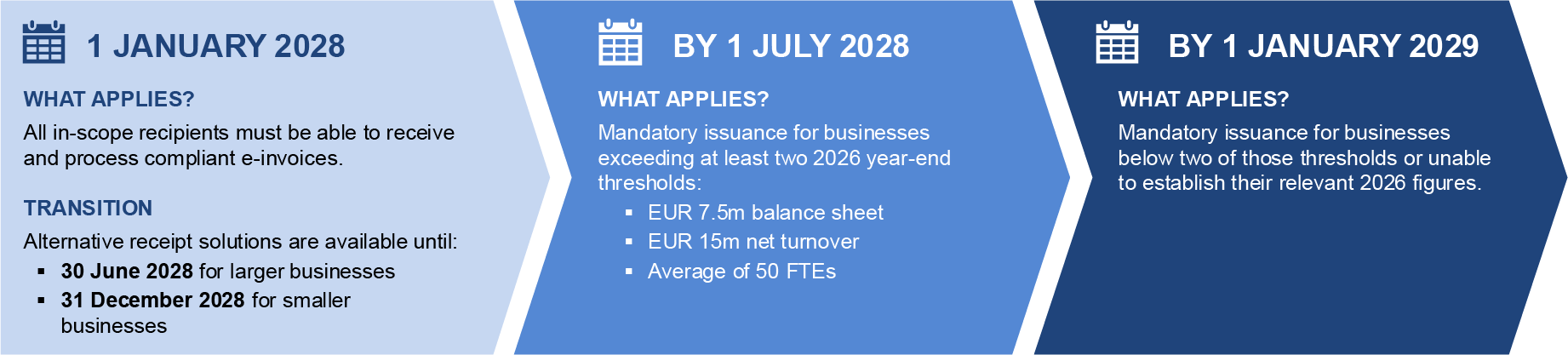
| Key takeaways – The obligations in relation to the reception of e-invoices would come into force from 1st January 2028. Businesses would be able to use transitional alternative technical solutions until 30 June 2028 (and small businesses until 31 December 2028); – The obligations to issue and to transmit e-invoices would come into force from 1st July 2028 at the latest except for small business for which these obligations would come into force by 1st January 2029 at the latest. |
The Luxembourg reform is intended to help businesses prepare gradually. Several neighbouring countries are already implementing or preparing domestic B2B mandates (Belgium since 1 January 2026, France by 1 September 2027 and Germany by 1 January 2028), while ViDA will introduce EU-wide digital reporting for intra-Community transactions from 1 July 2030. The bill of law must now follow the ordinary legislative process and may therefore change before it is enacted.
Extended scope: domestic B2B added to B2G
The 2019 Law will now also apply to invoices:
- issued by a taxable person established in Luxembourg to a recipient also established in Luxembourg;
- for supplies whose place of taxation is in Luxembourg (such as real estate transactions); and
- provided the transaction is subject to a VAT invoicing obligation (transactions not subject to a mandatory invoice as per Article 63 of the VAT Law are thus excluded, such as insurance and fund management).
Some categories remain excluded:
- certain specific and occasional transactions performed by/with private individuals (sale of new cars, transactions relating to a principal residence); and
- certain B2C intra-Community distance sales of goods.
What counts as a “compliant e-invoice”?
The bill of law defines a “compliant electronic invoice” as one complying with the European e-invoicing standard and an authorised syntax under Directive 2014/55/EU.
A PDF, Word file or scanned image will not qualify — only a structured, machine-readable format will do, and only that file has legal status as the invoice, even if human-readable attachments are appended.
The bill of law also clarifies that the e-invoicing regime is without prejudice to other legal requirements concerning information that must be included on mandatory invoices, such as:
- VAT details under Article 63 of the VAT Law
- Trade register details
- Business authorisation numbers
Recipients within scope must receive and process every compliant e-invoice and cannot reject an invoice merely because it is electronic. Acceptance by the recipient is no longer required in this context.
Common delivery network
Issuance, transmission and receipt will run through a single common delivery network, to be designated based on statutory criteria (interoperability, openness, digital sovereignty, security, data protection) and likely to be Peppol, which is used for the current B2G regime.
Businesses not yet connected may rely on alternatives (manual-only tools: broadly, the existing MyGuichet.lu solutions), subject to progressive usage fees.
Expected timeline
Practical implications
Although these deadlines may look distant, businesses should:
- Start mapping their invoicing flows now to identify in-scope transactions (domestic, Luxembourg place of taxation, subject to a VAT invoicing obligation).
- Adapt invoicing, accounting, accounts payable/receivable and archiving processes to handle structured files and return messages rather than PDFs. Notably, the bill of law also adapts the VAT Law’s invoice storage rules (Article 65) to ensure they apply in a technology-neutral manner to accommodate e-invoices.
- Groups operating across several Member States will also need to factor in differing national timelines and the further EU-wide digital reporting obligations applicable from 1 July 2030 under ViDA.
With the bill of law now before Parliament, the question is no longer whether domestic e-invoicing is coming, but how quickly businesses need to be ready.

How we can help
Our VAT & Indirect Taxation team is available to help you assess the impact of these changes on your business, map your invoicing flows against the new scope and prepare for the phased entry into force of the new obligations.