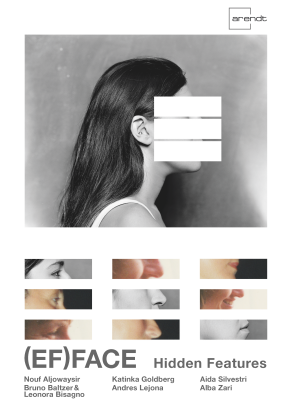
(EF)FACE – Hidden Features
(EF)FACE – Hidden Features examines the face as a constructed surface. Situated at the threshold between appearance and disappearance, figuration and abstraction, the exhibition approaches erasure not as absence, but as a discursive and aesthetic strategy. Rather than negating presence, concealment reconfigures it.
About the exhibition
(EF)FACE – Hidden Features examines the face as a constructed surface. Situated at the threshold between appearance and disappearance, figuration and abstraction, the exhibition approaches erasure not as absence, but as a discursive and aesthetic strategy. Rather than negating presence, concealment reconfigures it.
What remains when the face is withdrawn? When the image ceases to function as a mirror and instead becomes an unstable terrain, a place where identity fragments, shifts and recomposes itself?
Through photography and contemporary image-making, (EF)FACE – Hidden Features focuses on the precise moment when human features begin to waver: shifting from portrait to imprint, from visible to veiled, from certainty to spectral presence. The exhibition examines how concealment, alterations and distortion transform the face from a fixed marker of identity into a fluid and contested surface.
Erasure appears here in multiple forms, as protection, resistance and retreat, but also as a critical tool. Yet the face is not simply deleted. In many of the works presented, the features are partially obscured, layered, masked or displaced. The face persists, but it is interrupted.
In an era dominated by facial recognition technologies, biometric surveillance and the global circulation of portraits, the face is more exposed than ever, being archived, scanned, shared and analysed. This hypervisibility also reveals its fragility.
The work of Bruno Baltzer and Leonora Bisagno addresses the circulation of political imagery. Produced during their residency in China, the project centres on the iconic portrait of Mao Zedong in Tiananmen Square. When viewed through the smartphone screens of tourists photographing the mural, the image fragments and multiplies. Reframed in this format, the monumental face dissolves into repetition and technological mediation.
In the works of Katinka Goldberg and Alba Zari, erasure shifts toward a more intimate and genealogical terrain. Both artists engage with inherited histories through distinct visual strategies that destabilise the face as a site of certainty.
Katinka Goldberg’s work investigates the stories of her ancestors. In her portraits, facial features are not erased but are instead replaced by natural elements drawn from the landscapes along the path her grandparents were forced to take.
The face becomes a site of layered memory, where personal history merges with geography. By replacing features with fragments of nature, Goldberg transforms the portrait into a field of remembrance. The hidden face becomes an embodied archive.
Alba Zari’s artistic practice unfolds similarly as an investigation into origin. After discovering that she does not share the same father and heritage as her brother, she began reconstructing her paternal lineage through DNA testing, archival research and digital modelling. Using the results of her research, she pieces together a version of what her biological father may look like. To do this, she breaks down and analyses elements of her own face and those of her family to imagine that of an unknown person.
Aida Silvestri approaches the face through the lens of lived experience and migration. In her series Even This Will Pass, she portrays African migrants who have undertaken perilous journeys to reach Europe. Through carefully composed portraits accompanied by personal testimonies, Silvestri restores a sense of individuality to stories that are often reduced to statistics. The faces here become a reflection of dignity and resilience, rejecting erasure in the face of displacement and geopolitical invisibility.
Nouf Aljowaysir explores the dynamics of visibility within cultural and gendered frameworks, where representation is closely tied to power. In her work, veiling and fragmentation operate not as mere aesthetic devices, but as deliberate negotiations of agency and self-determination. In Salaf, she uses Artificial Intelligence to interrogate the past rather than to speculate on the future, creating a counter-dataset that resists easy recognition. By introducing opacity into algorithmic systems that are trained on historically biased archives, she disrupts the reproduction of orientalist narratives and reclaims concealment as a critical strategy.
Across multiple series throughout his career, Andres Lejona has consistently engaged with the aesthetics of the hidden face. Whether through masks, coverings, playful obstructions or carefully staged compositions, he repeatedly disrupts direct visibility. In his work, the face is offered as transparent or fully accessible, it is filtered, displaced or withheld.
The hidden face becomes both humorous and critical, a device that exposes the instability of visibility itself.
(EF)FACE – Hidden Features proposes a sensitive and critical journey through contemporary image culture. The exhibition reveals the face not as a stable signifier of identity, but as a fluctuating canvas that encompasses political icons, family archives, migration narratives and algorithmic reconstructions.
What withdraws from visibility opens a space for interpretation. Far from disappearing, the face emerges as a site of resistance, projection and questioning, an unstable surface where identity is continuously negotiated.
Claire di Felice, curator