AI at Arendt


Artificial Intelligence at Arendt
Arendt uses AI as an enabler of innovation, efficiency and service quality, while preserving the confidentiality, integrity, data protection and security principles and high professional standards that define our work. People, professional judgement and trust remain our foundation, reflecting our commitment to making sure AI is used in a purposeful, controlled and trustworthy way, in the best interest of our people and our clients.
To reach these goals, we put in place specific governance measures. A dedicated AI Task Force sets our strategy, a network of AI champions ensures firmwide awareness and adoption, and AI specialists develop and deploy solutions and tools firmwide.
“AI is at the heart of our strategy, giving us greater speed, depth and precision for our clients. But expertise, insight and judgement remain what matters most — and our priority is to pass them on, as they were passed to us, through mentorship.“
Alexandra Cabannes – Director Knowledge Management
Our approach
We take a thoughtful, strategic approach to AI adoption, giving all our people access to secured best-in-class tools that are embedded seamlessly into our daily workflows.
Legora provides specialised legal AI for client matters, while Microsoft Copilot supports operational tasks within our secure Microsoft 365 environment. Alongside these, we build and automate our own solutions to deliver consistently high-quality results.
We support AI adoption through tailored training, continuous learning initiatives and fostering knowledge sharing across the firm.
To stay at the forefront of innovation, we continuously assess emerging technologies and selectively scale those that meet our standards for effectiveness, security, confidentiality, data protection and compliance.

What is important for us
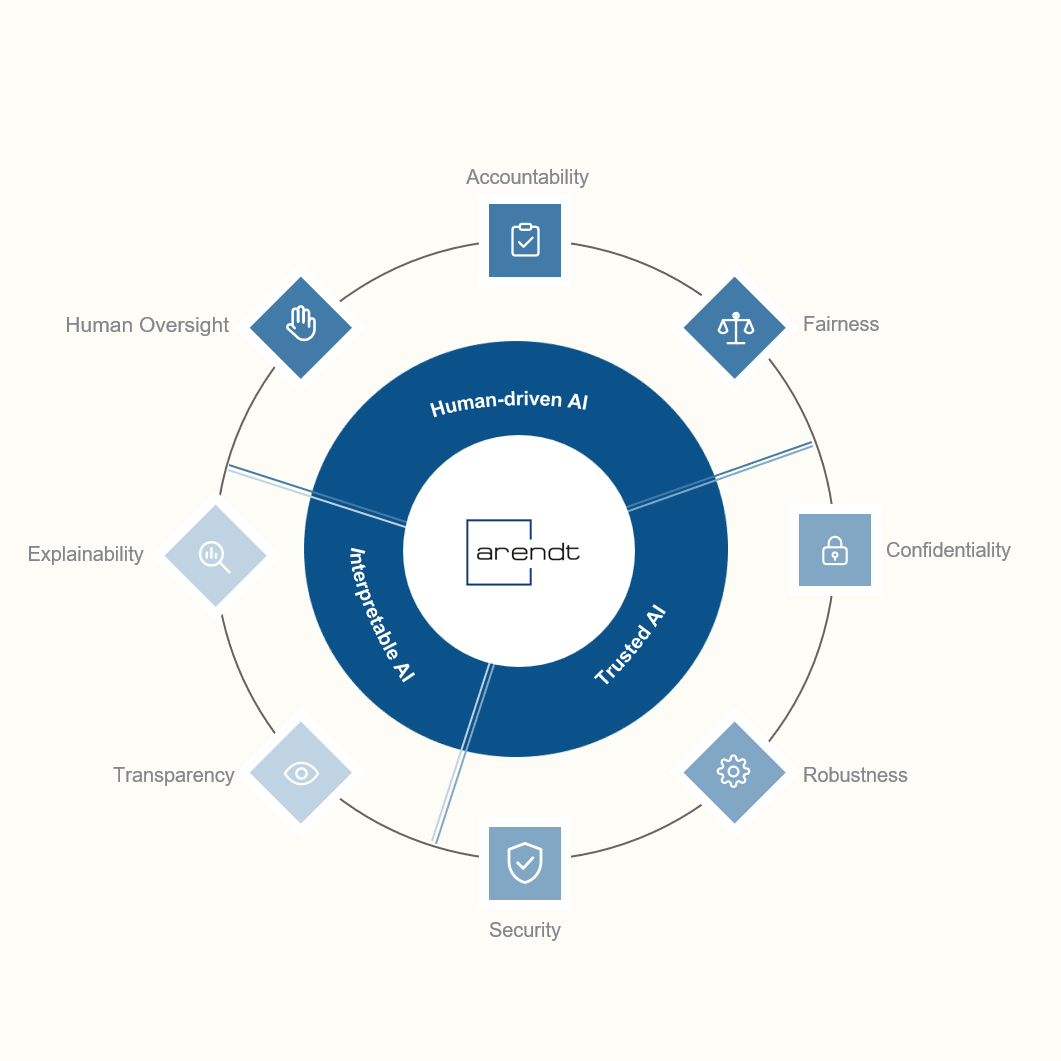
Our Responsible AI Principles provide a common foundation for the procurement, development, deployment and use of AI across the firm.
Organised around Human-driven AI, Trusted AI and Interpretable AI, these pillars support responsible innovation while safeguarding professional judgement, individual rights and the information entrusted to us.
“With a centralised framework and clear governance, we are making sure that AI use at Arendt is purposeful, controlled and trustworthy, with human judgement always having the final word.“
Anke Joubert – AI & Data Transformation lead
AI supports human decision-making; it does not replace it. Professional judgement stays central, and responsibility for decisions always rests with our people.
Related terms:
Professional judgement – Human agency – Verification
Clear ownership is required: defined governance, approval and oversight processes apply across the AI lifecycle, at every level of the firm.
Related terms:
Ownership – Responsibility – Governance
AI is developed, selected and used in a manner that respects individuals’ rights and legitimate interests. Fair and non-discriminatory outcomes are promoted through the design, governance, deployment and oversight of AI throughout its lifecycle.
Related terms:
Bias – Discrimination – Inclusivity
Safeguarding the information entrusted to us is a precondition of any use of AI. AI is developed, selected and used in a manner that protects confidentiality, privacy and data protection principles and professional secrecy, in accordance with applicable legal, regulatory and client requirements.
Related terms:
Data protection - Client confidentiality - Privacy
The robustness of AI systems and outputs is maintained through the lifecycle by appropriate design, validation, deployment and oversight.
Related terms:
Consistency – Accuracy - Reliability
Security is integrated into the procurement, development, deployment and operation of AI. AI systems, data and integrations are protected against unauthorised access, manipulation, misuse and disruption through proportionate security measures throughout their lifecycle.
Related terms:
Safety – Threat protection – Access control
AI use is transparent and appropriately disclosed. Required notice is provided, and transparency obligations, client disclosures and restrictions relating to AI use are respected.
Related terms:
Traceability – Disclosure – Documentation
AI-assisted outputs must be understandable, reviewable and capable of being challenged by those responsible for them. The level of explainability provided is proportionate to the purpose, context and risk of the AI use case.
Related terms:
Interpretability – Comprehensibility – Testability
Relevant links

How we can help
If you have any questions or comments regarding Arendt’s AI journey, please contact our Artificial Intelligence team at AI@arendt.com.